
DSMC-Neutrals Case Study - Rarefied Ionization Flow Simulation
DSMC-Neutrals is a 3D rarefied gas analysis software package that utilizes the Direct Simulation Monte Carlo (DSMC) method. By employing an unstructured mesh, it enables simulations of complex geometries. It also supports chemical reaction calculations, making it suitable not only for simulating rarefied gas flows within vacuum chambers but also for modeling thin-film deposition in semiconductor manufacturing processes such as Chemical Vapor Deposition (CVD). If reading this article has made you even slightly interested in rarefied gas analysis or gas flow simulation, please feel free to contact us at any time to request materials or for further information.
Rarefied Ionization Flow Simulation
When a spacecraft re-enters the atmosphere at hypersonic speeds, the gas surrounding the vehicle undergoes compression and heating due to strong shock waves,
accompanied by chemical reactions such as dissociation and ionization.
In particular, electrons generated through ionization affect radio wave propagation around the spacecraft and can cause communication blackouts.
In high-altitude rarefied regions, continuum models based on the Navier-Stokes equations are difficult to apply.
Furthermore, reproducing these conditions in ground-based experimental facilities is challenging.
Therefore, the DSMC method, which statistically models the motion of gas molecules, is widely used to analyze rarefied hypersonic flows.
In this case study, DSMC-Neutrals is used to simulate ionization reactions by extending the DSMC method to include ionization processes.
The RAM-C II flight experiment, a well-established benchmark for investigating ionization phenomena during hypersonic atmospheric re-entry,
is used as the reference case.
The electron number density obtained from the simulation is compared with flight-test data reported in [1] to evaluate the agreement between the numerical results and experimental measurements.
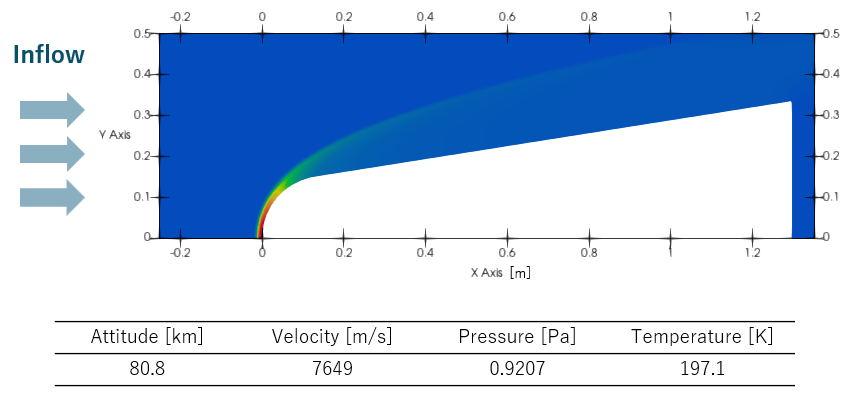
▲ Computational Domain and Boundary Conditions
Chemical Reaction Model
The Total Collision Energy (TCE) model is used for chemical reaction calculations.
Reaction probabilities are determined based on the total collision energy and the Arrhenius rate coefficients.
The reaction equations and parameters, including those for ions and electrons, are based on the model proposed by Gupta et al. [2].
Artificial Electron Mass Amplification
When analyzing rarefied flows involving ionization using the DSMC method,
electrons move significantly faster than atoms and molecules at the same temperature because of their extremely small mass.
Consequently, using the actual electron mass requires an extremely small time step to track electron motion,
resulting in a substantial computational cost.
To address this issue, models that artificially increase the electron mass for computational purposes have been proposed [3, 4].
In this case study, the electron mass is set to 1,000 times its actual value,
following the approach adopted in [4].
Results
The results obtained using DSMC-Neutrals are shown below.
Although some of the simulation conditions may differ from those used in the reference study,
the electron number density at the probe locations shows reasonable agreement with the flight-test measurements reported in [1].
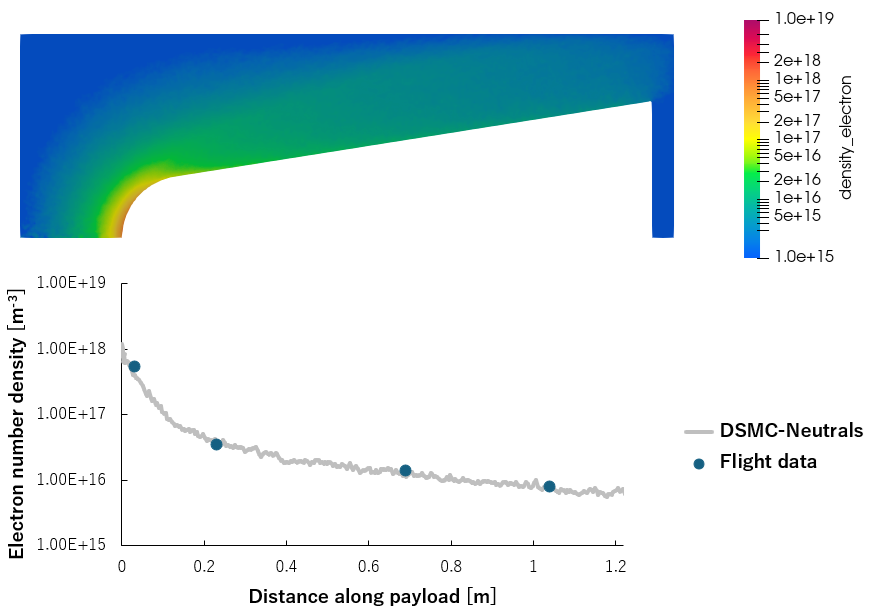
▲ Comparison of Simulated Electron Number Density and Measurements
at Probe Locations in the RAM-C II Flight Experiment
References
-
Jones Jr, W. Linwood, and Aubrey E.,
Cross. No. L-7984 (1972),
https://ntrs.nasa.gov/citations/19720011555

-
Gupta, Roop N., et al.,
No. L-16634 (1990),
https://ntrs.nasa.gov/citations/19900017748
-
Boyd, Iain D.,
Physics of Fluids, 19.9 (2007),
https://pubs.aip.org/aip/pof/article-abstract/19/9/096102/257303/Modeling-of-associative-ionization-reactions-in
-
Fang, Ming, et al.,
Advances in Aerodynamics, 2.1 (2020): 7,
https://link.springer.com/article/10.1186/s42774-020-00030-1